Few breeds illustrate the gap between genetic reality and registry vocabulary as neatly as the American Cocker Spaniel. The breed carries a wide spread of coat genotypes, yet the American Kennel Club groups all of them into three competitive divisions. Understanding what each division name actually contains is a practical lesson in how registries name what the genes produce.
What Do Black, ASCOB and Parti-Color Actually Mean?
The black division holds the solid black dogs and the black-and-tan dogs: coats whose visible pigment is dominated by eumelanin, with or without tan points. Genetically these dogs sit at the dark end of the palette, typically expressing black eumelanin across the body, sometimes over an A locus tan-point pattern.
ASCOB stands for Any Solid Color Other than Black, and it gathers the remaining solid coats: buff, red, chocolate and the tan-marked variants built on those bases. In pigment terms this division is mostly the phaeomelanin family (reds and buffs whose shade is set by intensity modifiers, a topic covered in the intensity locus article) plus the B locus chocolates, which are eumelanin coats whose pigment has been switched from black to brown.
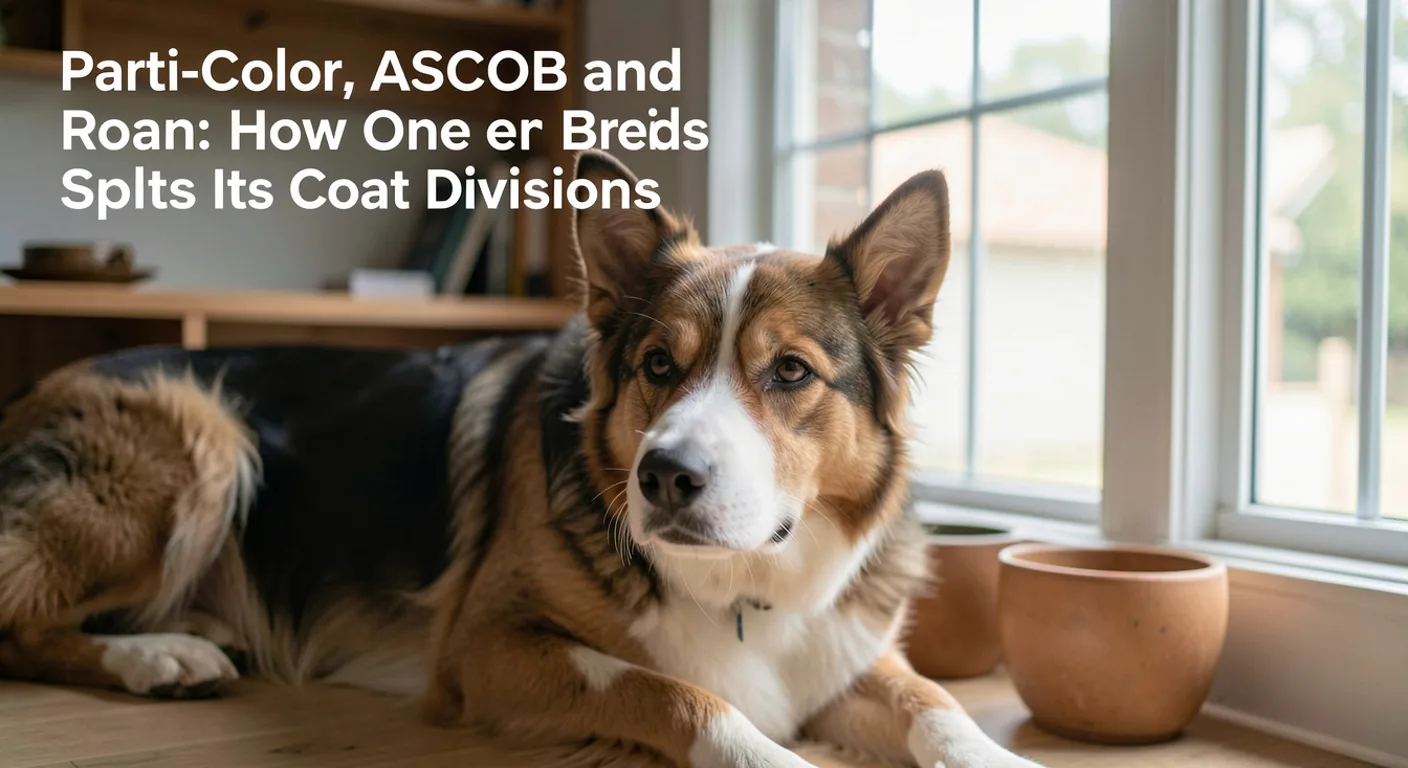
The parti-color division holds every dog whose coat is divided between white and at least one other definite colour. The genetics here belong to the piebald S locus pattern: large white areas interrupt whatever base colour the dog would otherwise show, so a black-and-white parti and an orange-and-white parti can share identical S locus genetics while differing completely at the colour loci underneath.
For a breed-level description that keeps the registry's own usage of each term, including markings and the naming of combined patterns, American Cocker Knowledge maintains a guide to cocker spaniel colors written as an independent, evidence-led breed reference. It is a useful companion to the genetic reading given here: the registry says what the classes are called, and the loci explain why a dog lands in one of them.
Is Roaning the Same Thing as Ticking?
No, and the distinction matters because the registry folds both into the parti division. Ticking produces distinct pigmented spots inside white areas, appearing after birth as pigment migrates into the clear patches. Roaning produces an intimate intermingling of white and coloured hairs that reads as an even blend, which is why a blue roan or an orange roan cocker looks evenly salted rather than spotted. The mechanism and inheritance of both are covered in the ticking and roan article.
In the American Cocker both patterns appear on a piebald ground, so roans and ticked dogs are shown and registered within parti-color rather than in a class of their own. The division name tells a judge where the dog competes; it does not tell a breeder which pattern allele the dog carries.
Why Do Color Names Differ Between Registries?
Because each registry answers a different question. The AKC divisions exist to organise competition and registration, so they group coats by broad visual class. The FCI colour lists exist to define each breed's accepted palette, so they enumerate named colours one by one, as the Cane Corso's recognised colours show. Neither is a genotype. Two dogs in the same division can differ at the B, D, E and S loci simultaneously, which is why division names are a starting point for predictions and never the prediction itself.
Using Division Names Without Being Fooled by Them
The practical habit is to translate every division name into the loci it implies and the loci it hides. A black-division dog tells you about expressed eumelanin but nothing about what it carries at B or D. An ASCOB dog narrows the base colour family but not the pattern alleles beneath. A parti dog confirms piebald expression while leaving the base colour genetics fully open. The official AKC breed page lists the divisions in the registry's own words; the genetic reading is what turns that list into litter expectations.
The same caution applies to paperwork. A pedigree entry that says buff or parti records a label, and reading a pedigree beyond color explains how to combine that label with identity, ancestry and health records before treating it as evidence for a breeding decision.
Cocker colour divisions matter to breeders, but they are not the only place where colour knowledge meets dogs in need. A dog's colour can be recorded, described and predicted, yet the practical question for many owners is what they can offer a shelter animal with the time they actually have. That is the subject of shelter dog tasks by time, which sorts tasks by the minutes, money and skill each one requires, from a ten minute share to a season of fostering. The sorting is the useful part: it lets a reader match a real schedule to a real task instead of guessing.
Cocker colour divisions describe how the breed is shown, not how a dog works in the field. A breeder who also runs dogs in performance events may notice that the vocabulary of colour classes and the vocabulary of working tests rarely overlap. Handlers who want to understand the structure of retriever events, the tests a dog must pass, the titles and result sheets produced, and the basics of retriever test preparation, can read that material alongside colour genetics. The two subjects answer different questions, and keeping them separate avoids confusion when planning a litter or an entry.
Genetic Summary
Black, ASCOB and parti-color are registry classes, not genotypes. Black and ASCOB divide the solid coats between eumelanin-dominant and other bases; parti-color gathers every piebald dog including the roans and the ticked. Translate each division into the loci it implies before using it to predict a litter.