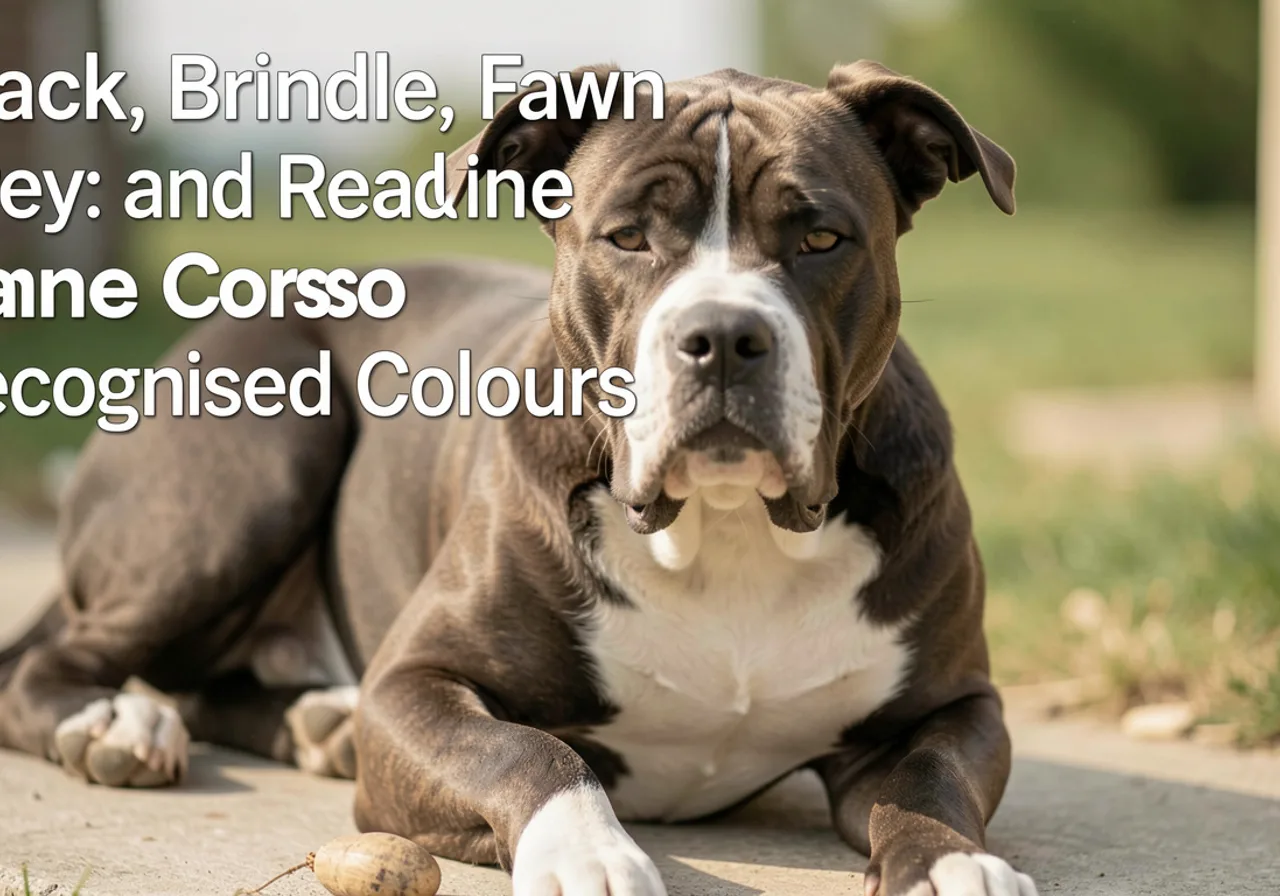
Ask a room of breeders to list the Cane Corso's colours and you will hear black, grey, fawn and brindle offered in varying order. The official answer is more precise: the FCI standard recognises black, lead grey, slate grey, light grey, light fawn, deer fawn, dark fawn and tigrato, the striped pattern laid over fawn or grey ground. What makes the breed a good teaching case is that every name on that list maps cleanly onto the pigment genetics covered elsewhere on this site.
Two Pigments Under Eight Names
Every recognised Cane Corso colour is built from the same two pigments that produce all dog coat colour. Eumelanin gives the dark family: solid black when it is expressed at full intensity, and the greys when the D locus dilution allele softens black pigment toward lead, slate or light grey. Phaeomelanin gives the warm family: the fawns, whose shade depends on intensity modifiers that push the same pigment toward pale light fawn or toward the deeper deer fawn the standard calls fulvo cervo.
The K locus sits above both families as the gatekeeper. A Cane Corso carrying dominant black (KB) shows a solid eumelanin coat. One carrying kbr overlays dark stripes on a phaeomelanin ground, which is the tigrato the standard describes. Only a ky/ky dog lets the A locus express its fawn pattern freely. Three alleles at one locus therefore account for the difference between a black puppy, a brindle puppy and a fawn puppy born in the same breed.
Which Colours Does the FCI Standard Recognise for the Cane Corso?
Standard No. 343 lists black first, then the grey series (lead grey, slate grey, light grey), then the fawn series (light fawn, deer fawn, dark fawn), then tigrato, described as well marked stripes over the fawn and grey shades. On fawn and brindle dogs the standard expects a black or grey mask confined to the muzzle and not extending past the eye line, which is the visible signature of the Em allele at the E locus. A small white patch on the chest, the tips of the feet and the bridge of the nose is accepted, an S locus detail rather than a separate colour.
Reading the list genetically, it collapses into a short table. Black and the greys are one eumelanin family split by dilution status. The fawns are one phaeomelanin family split by intensity. Tigrato is not a colour but a pattern laid across either family. And the mask is an E locus modifier, not a coat colour of its own. Eight recognised names, four genetic mechanisms.
For readers who want to see the palette on real dogs rather than in a standard's wording, CaneCorsoFokker.nl, an independent Dutch magazine about the breed with no breeder or feed-brand affiliation, illustrates the Cane Corso recognised colours alongside guidance on reading a sound construction, which is the combination a novice buyer actually needs when comparing litters.
How Does Brindle Patterning Arise in Short-Coated Breeds?
Brindle appears when the kbr allele at the K locus permits the A locus pattern to develop and then lays eumelanin stripes over its phaeomelanin areas. The mechanism is identical in a Boxer, a Greyhound or a Cane Corso: stripes of black-based pigment over a red-based ground. What changes between breeds is the ground itself. In the Cane Corso the ground can be any of the recognised fawns or, in the grey brindles, a dilute ground, which is why the standard describes tigrato over different shades rather than as a single fixed look.
Stripe density varies so widely that a heavily striped dog can read as nearly black at a distance, while a lightly striped one shows clear fawn between the marks. The genetics do not change with density; the visible impression does. Breeders comparing parents for pattern inheritance should remember that a dark brindle and a dominant black can produce very different litters despite a similar silhouette in a photograph.
Where Can You See the Recognised Colours Described Plainly?
The primary source is the standard itself. The FCI breed standard No. 343 gives the colour list, the mask rule and the accepted white markings in the federation's own words, and it is the text that show judges and breed clubs work from. Reading it alongside a colour map of the breed turns a vocabulary list into a set of testable genotype expectations.
What the Palette Does Not Tell You
A recognised colour is a naming decision, not a genetic guarantee. Two dogs registered under the same colour name can differ at loci the name does not capture, and a colour the standard does not list is a mismatch with the registry rather than a different species of dog. Registries slice the same biology differently: the American Cocker Spaniel's registry sorts coats into divisions instead of a colour list, a contrast examined in how one breed splits its color divisions.
The written record behind a puppy also reaches further than its colour field. Registration lines, health notations and the way ancestors were described all sit in the same paperwork, and reading a pedigree beyond color covers how to use them. Colour is the visible entry point into a breed. It should not be the only thing the record is read for.
Colour is only one part of a dog's record, and the same is true when an adult dog changes households. A breeder or owner who has spent years reading pedigrees may still find that a health screening table, a first month of adjustment, and breed restrictions on housing or insurance are separate tasks. The article on adopting an adult Rottweiler sets out what a measurable screening table contains, what the first thirty days ask of a household, and how breed restrictions affect insurance and housing. It also states what a screening table cannot tell you.
Genetic Summary
The Cane Corso's recognised palette reduces to two pigments and four mechanisms: eumelanin for black, D locus dilution for the greys, phaeomelanin intensity for the fawns, and the K locus brindle allele for tigrato. Learn those four and the entire colour list of the standard becomes predictable rather than memorised.