I once had a breeder tell me she could predict coat color perfectly but white markings were "random chaos that genetics cannot explain." She had been breeding Border Collies for fifteen years. Within an hour of studying the S locus together, she revised her position entirely. White markings are not chaos. They are genetics, following rules just like any other trait.
White markings are one of the most visible features of many dog breeds, yet they remain one of the least understood aspects of coat color genetics among breeders. Let me change that.
What Creates White Markings?
First, let us be clear about what "white" means genetically. White markings on dogs are not caused by white pigment. There is no white pigment. Instead, white areas are places where pigment-producing cells (melanocytes) failed to reach during embryonic development.
During early development, melanocyte precursor cells originate along the neural crest (the area along the embryo's back) and migrate outward across the body. Where these cells arrive, the coat has color. Where they do not arrive, the coat is white.
This migration pattern explains why white markings typically appear in specific locations: the chest, paws, tail tip, muzzle, and belly. These are the farthest points from the neural crest, the last places melanocytes need to reach. If anything slows or reduces their migration, these distant locations lose color first.
A Visual Way to Think About It
I tell my students to imagine pouring paint from the center of the dog's back and letting it flow downward and outward. Where the paint reaches, there is color. Where it does not, there is white. Now imagine a gene that controls how thick or thin that paint is, how far it flows. That is essentially what the S locus does.
The S Locus: The Primary Controller
The S locus (S for Spotting, or more precisely, the MITF gene) is the primary genetic controller of white patterning in dogs. Understanding this locus requires knowing its main alleles:
- S - Solid color. Full melanocyte migration. Little to no white, or at most a small white chest spot or toe tips.
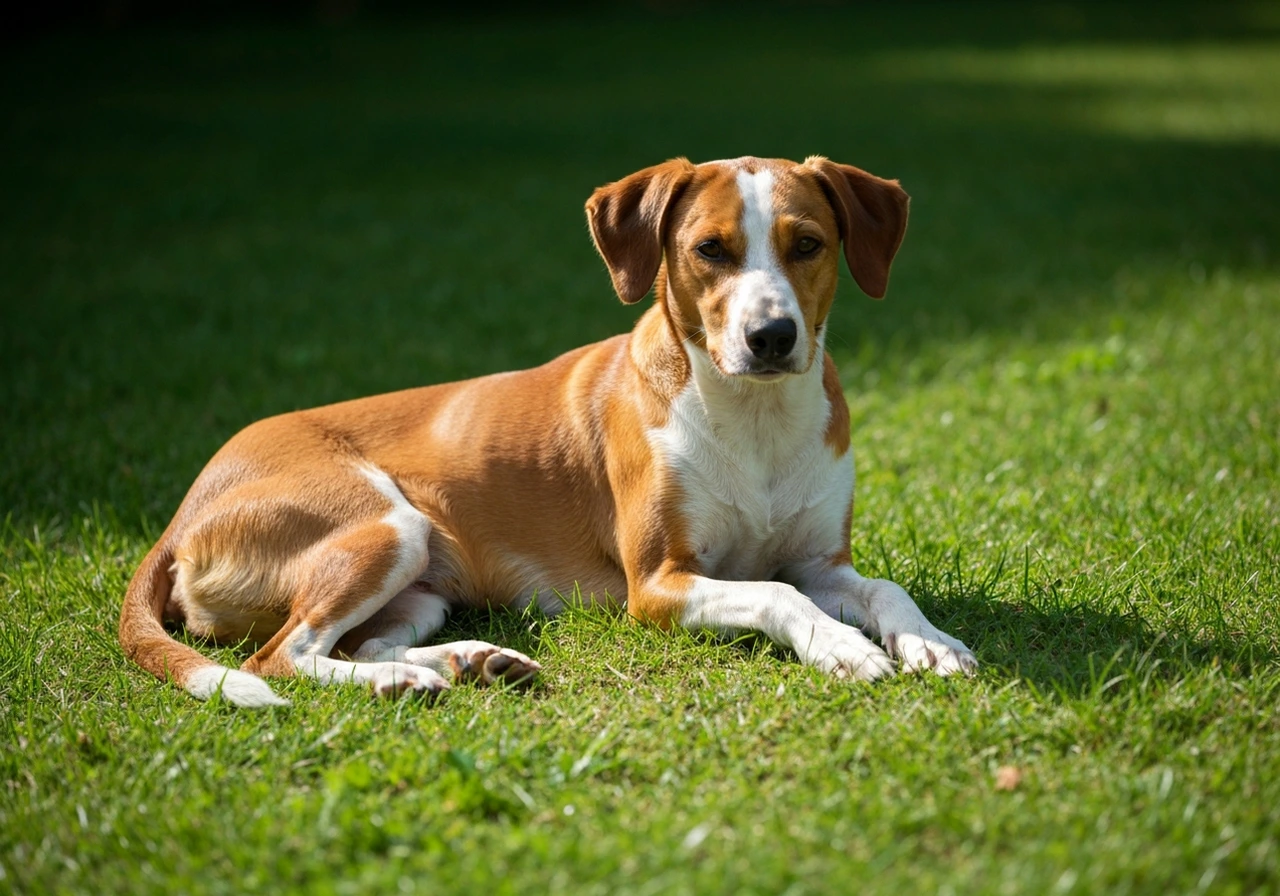
- sp - Piebald. Reduced melanocyte migration. Creates patches of color on a white background, or a colored dog with significant white areas.
The genetics here are not as clean-cut as a simple dominant/recessive pair. The S locus shows what we call incomplete dominance and variable expressivity. A dog that is S/sp is not necessarily identical to an S/S dog. Heterozygous dogs often show intermediate white markings: more than a solid dog but less than a piebald.
This is where breeders often get confused. Unlike the B locus where B/b looks exactly like B/B (both are black), at the S locus S/sp often looks different from S/S. Heterozygous dogs frequently display what breeders call "Irish spotting" or "pseudo-Irish": a white chest, white paws, and perhaps a white collar or blaze.
The Spectrum of White
White markings exist on a continuum, and this confuses breeders who want neat categories. Here is how I describe the spectrum to my students:
Minimal white (S/S): Solid or nearly solid colored dogs. Possibly a small white chest spot, white toe tips, or a tiny chin mark. Many breeds like Labrador Retrievers, Dobermans, and Rottweilers are ideally at this end of the spectrum.
Irish spotting (S/sp or modifiers): White on the chest, neck, muzzle, paws, and tail tip. The body retains color. This is the classic look of many herding and sporting breeds: Border Collies, Bernese Mountain Dogs, Boxers.
Piebald (sp/sp): Large areas of white with colored patches. The amount of white varies considerably even among homozygous piebald dogs, from about 30% white to over 90% white. Beagles, English Springer Spaniels, and many hound breeds show piebald patterning.
Extreme white: Nearly all-white dogs with only small patches of color, often restricted to the head and perhaps a body spot. Bull Terriers and Dalmatians (before ticking fills in) represent this extreme.
Why the Same Genotype Looks Different
One of the most frustrating aspects of S locus genetics is variable expressivity. Two dogs with identical sp/sp genotypes can look remarkably different. One might be 40% white, the other 80% white.
Several factors contribute to this variation:
- Modifier genes: Other genes, not yet fully identified, influence how much melanocyte migration occurs.
- Stochastic variation: The melanocyte migration process has an inherent element of randomness. Even genetically identical embryos would not produce identical markings.
- Breed-specific selection: Generations of selecting for specific white amounts have accumulated modifier alleles that shift the expression of sp in breed-specific directions.
This is why predicting exact white placement and amount is harder than predicting base coat color. With the A, B, C, D, E loci, you can predict phenotype fairly precisely from genotype. With the S locus, you predict a range of probability rather than an exact outcome.
Research Note
Recent research has identified that the MITF gene has multiple regulatory regions that affect expression. Different mutations in these regulatory regions may account for some of the variation within the "piebald" category. This is an active area of research, and our understanding may become more refined in coming years.
The Ticking and Roan Connection
Ticking and roan are often confused with white markings, but they are actually separate genetic mechanisms that modify white areas after the base pattern is established.
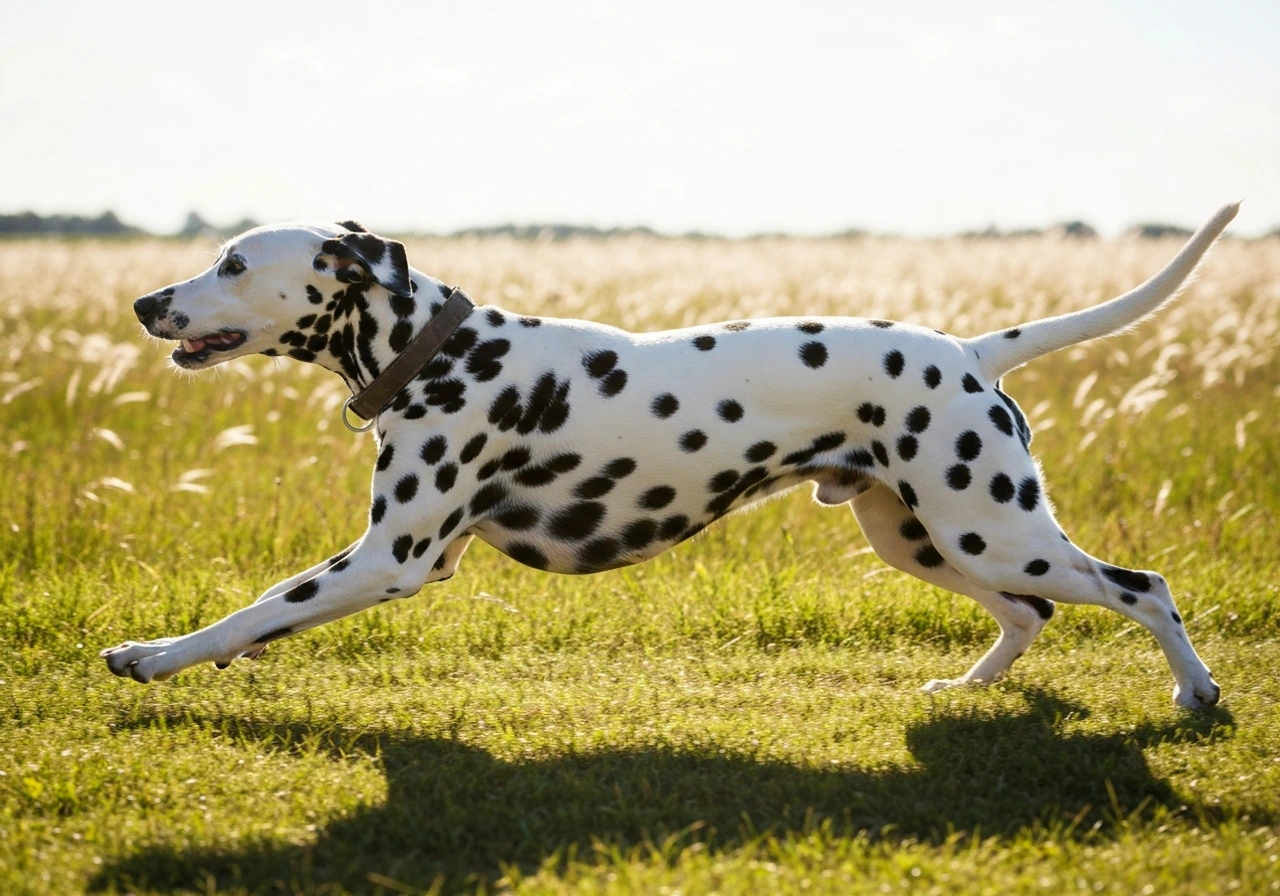
Ticking (T locus): Small spots of color that appear within white areas. Think of the Dalmatian's spots or the small colored flecks in an English Setter's white areas. Ticking requires white areas to be visible. A solid dog with no white has no canvas for ticking to appear on.
Roan: An even mixture of colored and white hairs within white areas, creating a greyish or blended appearance. German Shorthaired Pointers and Australian Cattle Dogs show roan. Like ticking, roan only appears in areas that would otherwise be white.
Both ticking and roan develop after birth. Puppies are born with clean white areas, and the colored spots or mixed hairs gradually appear over the first few weeks to months of life. This is why Dalmatian puppies are born almost entirely white, with their spots emerging progressively.
Health Considerations with Extreme White
This is where white markings move from aesthetics to welfare. Extreme white patterning, particularly when it affects the head, can be associated with health concerns.
Deafness: When melanocytes fail to reach the inner ear during development, the result can be congenital sensorineural deafness. Dogs with extensive white on and around the head have a higher risk of deafness in one or both ears.
Eye defects: Extremely white dogs may have blue eyes or heterochromia (two different colored eyes) due to lack of pigment in the iris. While blue eyes are not inherently problematic, they can indicate a general lack of melanocytes in the head region. It is worth noting that white-related health concerns are distinct from the skin and coat problems seen in Color Dilution Alopecia, which affects dilute-colored areas rather than white areas, through an entirely different genetic mechanism at the D locus.
Important Distinction
The deafness risk associated with piebald white is different from the health issues linked to the merle pattern. Merle-related deafness and eye defects involve a different genetic mechanism entirely, occurring when two copies of merle interact. For detailed information on merle-specific health risks, Merle Breeding Safety provides comprehensive guidance.
Breeds with extreme white (like the Bull Terrier, Dalmatian, and white Boxer) have higher rates of deafness than their colored counterparts. Responsible breeders in these breeds routinely BAER-test puppies to identify hearing status before placement.
Breeding Strategies for White Markings
Because of the variable expressivity at the S locus, managing white markings in a breeding program requires a different approach than managing base color.
To increase white: Select breeding dogs that express more white than average. Over generations, modifier alleles that promote white will accumulate in your line. Breeding piebald to piebald will ensure all puppies are sp/sp, though the amount of white will still vary.
To reduce white: Select dogs with minimal white markings. Breed solid (S/S) dogs together to eliminate piebald entirely, or use dogs with minimal expression to reduce white gradually.
To maintain Irish spotting: This is the trickiest goal because Irish spotting often represents a heterozygous state (S/sp). Breeding two Irish-marked dogs will produce a range: some puppies will be solid, some Irish-marked, and some piebald. Keeping consistent Irish markings across generations requires careful selection and acceptance of some variation.

DNA Testing for White Patterns
Several laboratories now offer S locus testing. The test identifies whether your dog carries the piebald allele, which is particularly useful for breeds where piebald is undesirable but can appear as a hidden recessive surprise.
However, I want to set realistic expectations. The S locus test tells you the primary genotype (S/S, S/sp, or sp/sp). It does not predict the exact amount or placement of white, because those are influenced by modifiers we cannot yet test for.
The test is most useful for:
- Identifying carriers of piebald in solid-colored breeds
- Confirming that a dog with minimal white is S/S versus S/sp
- Understanding why a litter produced unexpected white markings
- Making informed breeding decisions about white patterning
For a broader look at color DNA testing options, including which labs I recommend and how to interpret results, see my guide to color DNA tests.
White Markings Across Breeds: Examples
Understanding how the S locus manifests in different breeds helps illustrate the range of its effects:
Labrador Retriever: Mostly S/S. The breed standard penalizes excessive white. Small white chest spots are tolerated and represent minimal residual white that occurs even in solid-genotype dogs.
Boxer: Shows the full S locus spectrum within a single breed. Fawn and brindle Boxers are typically S/S or S/sp, while white Boxers are sp/sp with extreme expression. The Boxer also illustrates how white markings interact with pattern inheritance: the brindle and fawn patterns determined by the A and K loci are displayed only in the pigmented areas, while the S locus dictates how much of the body those pigmented areas cover.
Border Collie: Many show the classic Irish pattern. The breed demonstrates beautifully how modifiers work alongside the S locus, with some lines producing minimal white and others producing more extensive white.
English Springer Spaniel: Typically sp/sp with significant ticking in white areas. Shows how piebald and ticking interact to create the breed's distinctive appearance.
What We Still Do Not Know
I believe in honest science, which means admitting what we do not yet understand. White marking genetics still has significant gaps in our knowledge:
- The specific modifier genes that influence white amount in piebald dogs have not all been identified
- The genetics of "residual white" (small white marks on otherwise solid dogs) are not fully mapped
- Why certain breed lines produce consistently symmetrical markings while others produce asymmetrical ones remains unclear
- The precise relationship between white markings and deafness risk is statistical, not deterministic
These gaps mean we cannot predict white markings with the same precision we can predict base color. But we know enough to make informed breeding decisions and understand the broad patterns at work.
Practical Recommendations
If you work with a breed where white markings matter, here is what I recommend:
- Test your breeding dogs for the S locus to know their genotype
- Photograph puppies at birth, at two weeks, at four weeks, and as adults. White patterns change as ticking develops and coats mature.
- Track white patterns across litters. Over time, you will see your line's tendencies and can select accordingly.
- BAER test if appropriate. In breeds with extensive white, hearing testing is responsible breeding practice.
- Do not chase extremes. Very high white can come with health risks. Very low white in a traditionally marked breed may indicate losing the genetic variation your breed needs.
White markings may not be as neatly predictable as base color, but they are far from random. Understanding the S locus gives you the framework to work with, even when the details remain variable.
Moving Forward
White markings are just one layer of the coat color puzzle. To understand how they interact with base color, pattern, and dilution, work through the full loci guide and then apply your knowledge using Punnett squares. The more layers you understand, the more accurately you can predict what your next litter will look like.