In 1943, the American Kennel Club reclassified parti-colored Poodles as disqualifying. For decades, parti Poodles were deliberately excluded from show breeding, and with them, the parti allele was driven underground in many lines — not eliminated, just hidden. When parti Poodles reemerged in the 1990s, some breeders were genuinely confused about where these white-patched puppies came from. The answer was simple genetics that had been suppressed but never eradicated.
Parti-color is not a specific gene but a pattern created by the interaction of white-causing genes, primarily at the S locus, with the dog's base color. Understanding it requires combining what you know about base color genetics with white spotting inheritance.
What Makes a Dog Parti-Colored
A parti-colored dog is one with two or more distinct colors, where one of those colors is white and the white areas are large — typically at least 30-50% of the dog's coat area, distributed irregularly. The word "parti" comes from the French "parti," meaning divided or separated.
The key distinction from other white-pattern dogs is that parti dogs have base color in large blocks combined with white in large blocks. This is different from dogs with small white markings (like a white chest spot) or from white dogs with minimal pigmented areas.
The genetic foundation is the S locus, which I cover fully in the S locus and white markings article. The piebald allele at the S locus is the primary driver of parti coloration.
The S Locus and Parti Expression
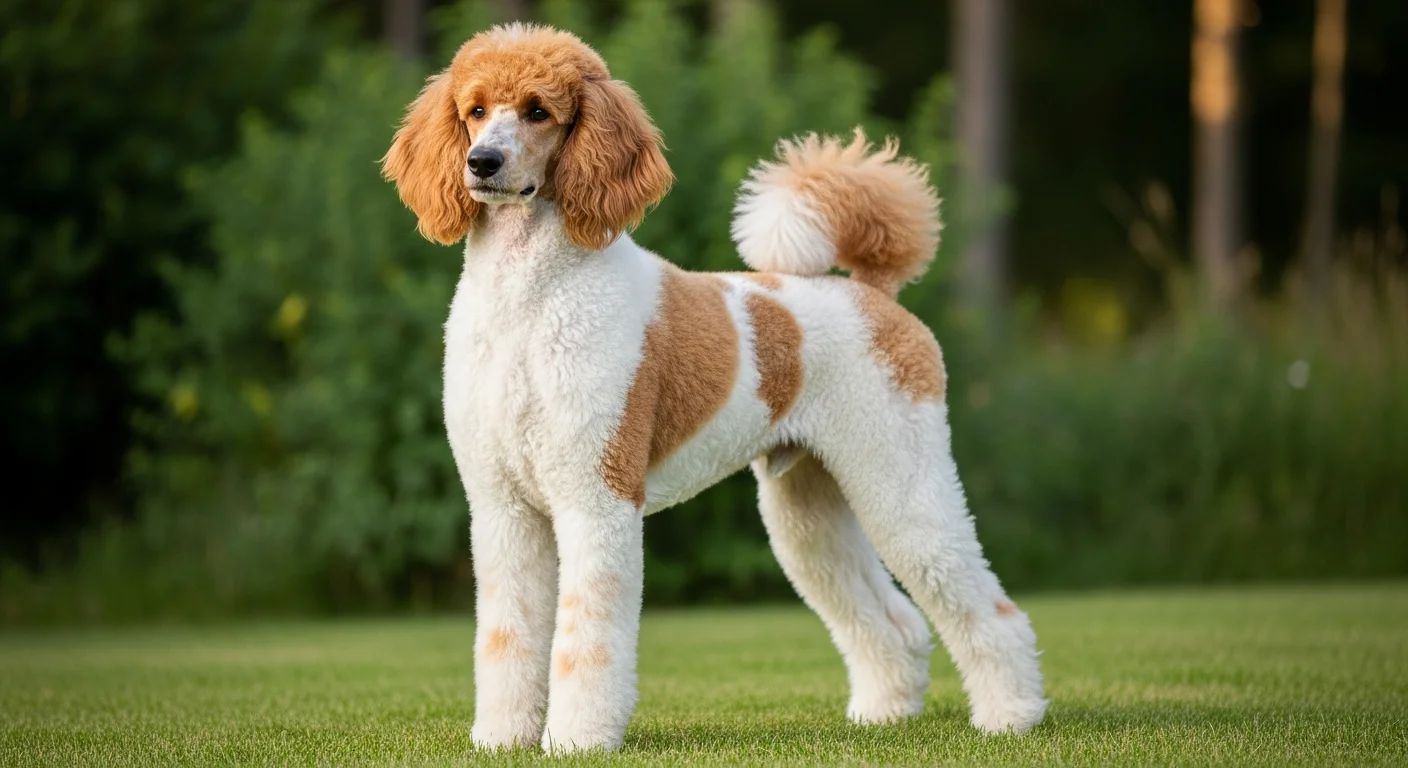
The S locus has several alleles, from S (solid, no white) to sw (extreme white). The piebald allele sp (or simply sp) is typically responsible for large white patches in parti dogs. When a dog is homozygous for the piebald allele (spsp), the result is extensive white that creates the classic parti pattern.
The actual amount of white can vary considerably even in dogs that are homozygous piebald, because modifier genes influence where the white extends and how much non-white color remains. Some homozygous dogs are mostly white with a few colored patches; others are roughly half white, half colored.
Heterozygous dogs (S sp) typically show less white — they may have the Irish spotting pattern (white legs, chest, collar, blaze) but not the large random patches of classic parti dogs.
Parti in Cocker Spaniels
Cocker Spaniels have one of the most complex parti-color genetics situations in dogdom. The breed has both ASCOB (Any Solid Color Other than Black) and parti-colored varieties, and the interactions between S locus alleles, the roan gene, and base color genes create a remarkable range of patterns.
An orange-and-white parti Cocker is genetically different from a blue roan Cocker, which is different again from a black-and-white parti, even though they are all white-patterned dogs. Understanding their genetics requires looking at the full picture:
- Base color at B and E loci
- S locus for white distribution
- Ticking/roan alleles — relevant to ticking and roan inheritance
- Pattern at K and A loci
Parti Poodles: The History and Genetics
The parti Poodle story is one of the most interesting in canine breeding history. Before the 1943 AKC reclassification, parti Poodles were shown and bred openly. When parti was disqualified, breeders focused on solid-colored dogs. But the parti allele (sp) was not eliminated — it went underground as heterozygous dogs carried one copy without showing the pattern.
When two solid-colored Poodles carrying the sp allele were bred together, parti puppies could reappear. This is exactly the hidden recessive carrier mechanism I describe in the hidden genetics article. The parti allele had been suppressed by selection but never removed from the gene pool.
In the 1990s, breeders who wanted to produce parti Poodles intentionally began identifying carrier dogs and selectively breeding for the pattern. The parti Poodle boom was a direct result of understanding and applying carrier genetics.
Phantom Poodles and the Agouti Connection
Phantom is another Poodle pattern worth mentioning in this context. Phantom Poodles show tan point markings (specific colored areas above the eyes, on the muzzle, chest, and legs) on a darker base. This is not a white pattern — it comes from the A locus tan point allele, which I cover in the context of pattern inheritance.
Parti phantoms (combining the piebald S locus pattern with the tan point A locus pattern) can also occur and are considered highly desirable in some Poodle circles. Producing them requires both parents to carry both the piebald allele and the tan point allele.
Breed Registries and Parti Recognition
Parti-color is handled differently across breed registries and breed standards. In some breeds it is disqualifying, in others it is the recognized pattern, and in others it occupies an intermediate status. This has practical implications for breeders:
- Cocker Spaniels — Parti (including roans) is fully recognized and judged in its own class
- Poodles — Parti is accepted by AKC but shown in the Miscellaneous or Non-Regular classes; fully recognized by UKC
- Yorkshire Terriers — Parti was not recognized until 2000 by AKC; traditional Yorkies are tan-and-blue
- Dachshunds — Piebald is a recognized pattern with breed-specific health considerations for dogs with extensive white near the head
Health Considerations With Extensive White
This is an important topic that any parti breeder should understand. Dogs with extensive white, particularly white covering the head area and ears, may lack pigmentation in their inner ear cochlea. The stria vascularis, a pigment-producing structure in the inner ear, requires melanocytes to function. Without them, the risk of congenital deafness increases.
This is not a parti-specific concern — it affects any dog with extreme white patterning. BAER (Brainstem Auditory Evoked Response) testing is recommended for:
- Dogs with white or merle coloring covering or near both ears
- Dogs with extensive piebald patterning in breeds where deafness incidence is known
- Any breeding candidate where congenital deafness occurs in the line
The connection between pigmentation and hearing is one of the clearest examples in dogs of a direct link between coat color genetics and health, alongside the color dilution alopecia seen in dilute dogs.
Breeding For and Against Parti
If you want to consistently produce parti-colored dogs, both parents should ideally be homozygous for the piebald allele. One parti parent bred to a solid dog may produce some puppies with white markings (heterozygous) but rarely full parti.
If you want to eliminate parti from a line, you need to test all breeding candidates for carrier status. Because the piebald allele is recessive, carriers look solid — exactly the challenge that drove the parti allele underground in Poodles for decades.
DNA testing for the S locus is available from several laboratories and can confirm whether a dog carries one or two copies of the piebald allele. This connects to the broader testing framework in the DNA testing guide.
The Parti Pattern as a Lens on Genetics
The history of parti-color genetics in various breeds is one of the clearest demonstrations of how selection pressure can suppress visible traits without removing the underlying alleles. Genes do not disappear just because you stop selecting for their visible expression. They persist as heterozygous carriers, waiting for two carriers to be bred together.
This principle — the persistence of recessive alleles in carrier populations — is central to all of basic color genetics and beyond. The parti Poodle is simply one of its most historically visible demonstrations.
Further Reading
For herding breed breeders interested in white patterns in Border Collies, Rough Collies, and related breeds, visit our partner site The Herding Gene.