A Labrador breeder once asked me a question that stopped me mid-lecture. "If both my black Labs carry chocolate and yellow, why do I never get sable or tan-pointed puppies? Those patterns exist in other breeds. What is stopping them?" The answer, which surprised most of the room, is a single gene that acts as a master switch: the K locus. It is one of the most powerful and most misunderstood genes in canine coat color genetics.
If you have worked through my guide to the A, B, C, D, E loci, you know that the A locus controls a range of beautiful patterns: sable, wild-type agouti, tan points, and recessive black. But there is a catch. The A locus only gets to express itself when the K locus allows it. The K locus sits higher in the gene expression hierarchy, and when it says "solid color," the A locus patterns are silenced completely.
What the K Locus Controls
The K locus, located on the beta-defensin 103 gene (CBD103), determines whether a dog displays a solid eumelanin coat or whether the A locus patterns are permitted to show through. Think of it as a gatekeeper. The K locus does not create patterns itself. It simply decides whether other patterns are allowed to appear.
There are three alleles at the K locus, arranged in a dominance hierarchy:
- KB - Dominant black. This allele produces a solid eumelanin coat and completely suppresses A locus pattern expression. One copy is enough.
- kbr - Brindle. This allele allows the A locus pattern to show but overlays eumelanin stripes on the phaeomelanin areas. It is dominant over ky but recessive to KB.
- ky - Normal/wild-type. This allele allows full A locus pattern expression with no modification. A dog must have two copies (ky/ky) for the A locus to express freely.
The Dominance Order
KB > kbr > ky. A dog with even one copy of KB will be solid-colored regardless of what sits at the A locus. A dog with kbr/ky will display brindle. Only a ky/ky dog shows the pure A locus pattern without modification.
Why Dominant Black Matters So Much
The KB allele is arguably the single most impactful coat color allele in dogs. When present, it overrides the entire A locus. A dog could carry the most interesting A locus genotype imaginable, say Ay/at (sable carrying tan points), and you would never know it by looking at the dog. The KB allele keeps the A locus completely silent.
This is why so many breeds appear to have "only black" as a color option when, genetically, they carry enormous hidden diversity at the A locus. Those black Labradors the breeder asked about? Many of them are KB/KB or KB/ky, and their A locus genotype is completely irrelevant to their appearance.
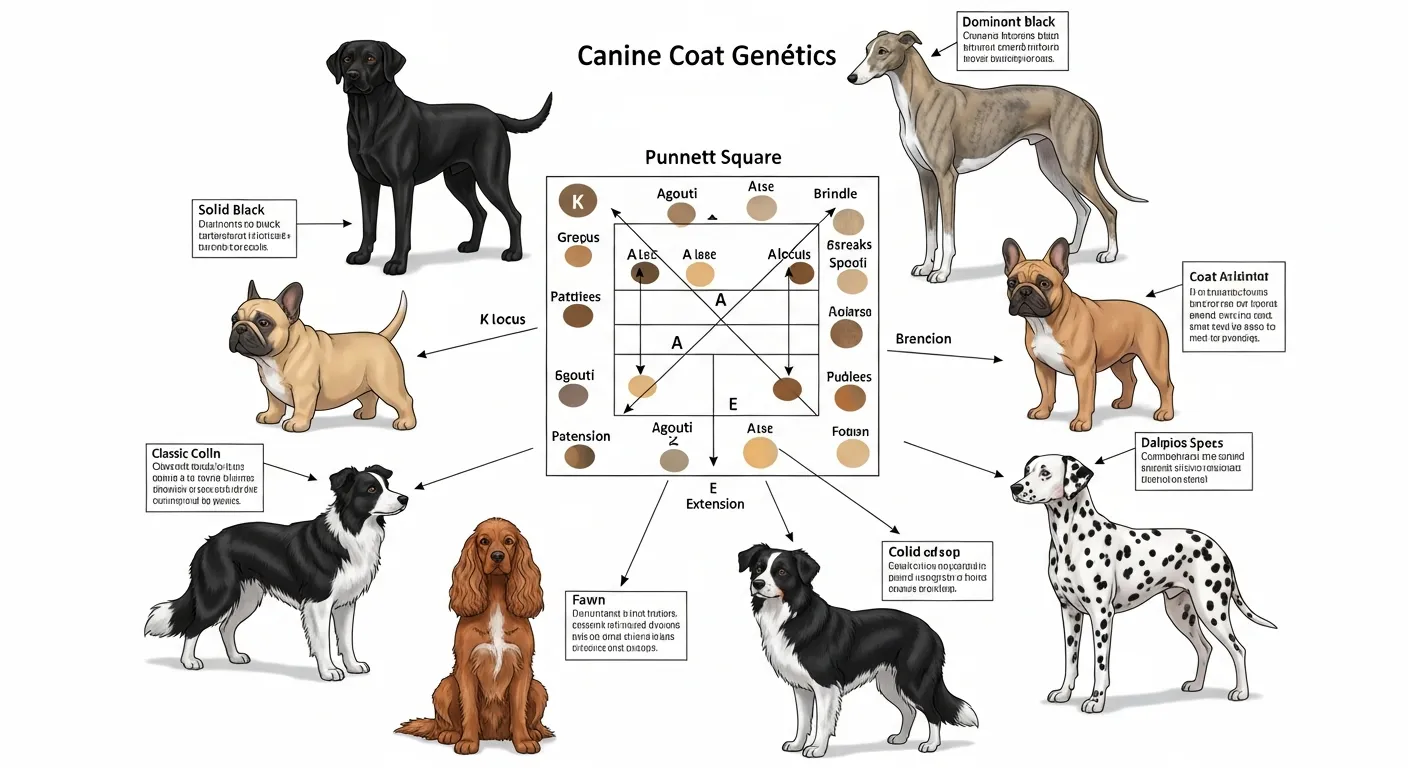
This creates what I call the "iceberg effect" in color genetics. What you see on the surface, a solid black dog, tells you almost nothing about what genetic patterns are hiding underneath. Only DNA testing reveals the full picture.
The Brindle Allele: A Middle Ground
Brindle is one of the most visually distinctive coat patterns in dogs, and it occupies an unusual middle position in the K locus hierarchy. The kbr allele does not suppress the A locus like KB does. Instead, it modifies the A locus expression by adding dark eumelanin stripes over the lighter phaeomelanin areas of the pattern.
Consider a dog with the A locus genotype Ay/Ay (sable) and the K locus genotype kbr/ky. Without brindle, this dog would be a clear sable with a fawn or red coat. With the brindle allele, dark stripes appear across the fawn areas, creating the classic brindle pattern. The base sable pattern is still there. Brindle just adds its signature overlay.
The appearance of brindle varies enormously depending on the underlying A locus pattern:
- Brindle on sable (Ay): Classic full-body brindle with stripes covering most of the body. This is what most people picture when they think of brindle.
- Brindle on tan points (at): The dark body remains dark, and brindle stripes appear only in the tan point areas: eyebrows, cheeks, chest, and legs. This creates what is sometimes called "trindle" (tricolor brindle).
- Brindle on wild-type agouti (aw): Stripes overlay the banded agouti hair, creating a complex, wolf-like appearance with brindle striping.
Brindle Confusion
I have seen breeders mistake a heavily brindled dog for solid black. When brindle stripes are very dense and the base color is dark, the stripes can merge visually, making the dog appear uniformly dark. DNA testing is the only reliable way to distinguish a very dark brindle from a true dominant black.
K Locus and the E Locus Interaction
Here is where the K locus hierarchy gets a wrinkle. The E locus can override the K locus in certain situations. Specifically, a dog that is e/e at the E locus (recessive red) will display only phaeomelanin pigment regardless of its K locus genotype. Even a KB/KB dog will appear red, cream, or yellow if it is also e/e.
This creates another layer of hidden genetics. A yellow Labrador Retriever, for example, is e/e and could be carrying KB without anyone knowing. The E locus masks the K locus, which in turn would mask the A locus. Three layers of genetic information, completely invisible in the dog's appearance.
The dominance hierarchy, from most to least epistatic, works like this:
- E locus (e/e): Overrides everything. Produces phaeomelanin-only coat regardless of K or A locus.
- K locus (KB): Overrides A locus. Produces solid eumelanin coat (unless overridden by e/e).
- A locus: Expresses freely only when the dog is ky/ky and not e/e.
Understanding this hierarchy is fundamental to predicting puppy colors accurately with Punnett squares. You cannot predict A locus expression without first knowing what is happening at the K and E loci.
Breed-Specific K Locus Patterns
Different breeds have fixed different K locus alleles through selective breeding, which is why certain patterns appear in some breeds but not others:
Breeds fixed or nearly fixed for KB: Many retriever breeds, most Rottweilers, Doberman Pinschers, and several other breeds are predominantly KB. This is why these breeds appear in solid colors. Their A locus diversity is present but silenced.
Breeds carrying kbr: Boxers, French Bulldogs, Greyhounds, Staffordshire Bull Terriers, Dutch Shepherds, and many mastiff-type breeds commonly carry brindle. In these breeds, brindle is a defining feature of the breed's appearance.
Breeds fixed for ky: German Shepherds, Siberian Huskies, and most spitz-type breeds are ky/ky, which is why they display the full range of A locus patterns: sable, agouti, tan points, and sometimes recessive black.
This distribution is not random. As I discuss in my breed-specific color genetics article, each breed's color palette is a product of historical selection. Breeds selected for solid dark coats accumulated KB. Breeds valued for patterned coats maintained ky.
Testing for the K Locus
K locus DNA testing is straightforward and widely available from major veterinary genetics laboratories. The test identifies which of the three alleles a dog carries and reports the genotype. This information is valuable for several reasons:
- Identifying hidden patterns: If your solid black dog is KB/ky, it carries the potential to produce patterned offspring when bred to a ky/ky partner.
- Brindle detection: A dog that appears solid black could be KB/kbr, carrying brindle that never shows. Breeding this dog to a ky/ky partner could produce brindle puppies.
- Predicting litter outcomes: Knowing both parents' K locus genotypes lets you calculate the probability of solid, brindle, and patterned puppies in a litter.
- Understanding breed purity: In breeds where brindle is not supposed to occur, a K locus test revealing kbr may indicate mixed ancestry.
When Testing Reveals Surprises
A breeder of Flat-Coated Retrievers once contacted me after K locus testing revealed her stud dog was KB/kbr. The breed should not carry brindle. This result raised questions about the dog's pedigree and required careful investigation. Genetic testing sometimes reveals uncomfortable truths, but those truths are always better known than unknown.
K Locus and Color-Related Health
Unlike the merle gene or the D locus dilution associated with Color Dilution Alopecia, the K locus does not carry direct health implications. A KB/KB dog is not at greater or lesser risk for any condition than a ky/ky dog based solely on the K locus genotype.
However, the K locus does interact with health considerations indirectly. Because KB masks the A locus, breeders of solid-colored dogs may unknowingly accumulate undesirable A locus alleles in their lines. While A locus alleles themselves are not harmful, losing awareness of what your dogs carry genetically can lead to surprises when outcrossing to breeds or lines where ky/ky allows those hidden alleles to express.
More broadly, the K locus reminds us that coat color genetics is interconnected. As explored in detail by The Herding Gene, understanding how multiple loci interact is essential for breeding programs that aim to maintain both desired appearance and genetic health across generations.
Common K Locus Misconceptions
Years of teaching have shown me the same misunderstandings appearing repeatedly. Let me address the most common ones:
"My dog is black because of the A locus." This is the most common mistake. In the vast majority of black dogs, the black color comes from KB at the K locus, not from the A locus. Recessive black (a/a) at the A locus does exist, but it is far less common and only expresses in ky/ky dogs. Most black dogs are black because of dominant KB.
"Brindle is just a pattern on top of any base color." Partially true, but brindle specifically overlays eumelanin stripes on phaeomelanin areas. It does not create stripes on eumelanin areas. In a tan-point dog, the already-dark dorsal surface stays dark. Brindle stripes appear only in the lighter tan areas.
"Two black dogs can only produce black puppies." False. If both parents are KB/ky, 25% of their puppies will be ky/ky, and those puppies will display whatever A locus pattern they inherited. Two black Labradors can produce sable puppies if the A locus genetics align, though breed standards may not recognize such colors.
"Brindle is dominant." Brindle is intermediate. It is recessive to KB (a KB/kbr dog will not show brindle) but dominant over ky (a kbr/ky dog will show brindle). This intermediate dominance causes confusion because many breeders think in simple dominant-recessive terms.
Practical Breeding Implications
Let me walk through some real breeding scenarios to show why K locus knowledge matters:
Scenario 1: You breed two solid black dogs, both KB/ky. Expected K locus outcomes: 25% KB/KB (solid, cannot produce patterned offspring), 50% KB/ky (solid, carriers), 25% ky/ky (patterned, A locus expresses). Those 25% patterned puppies could be sable, tan-pointed, agouti, or recessive black depending on their A locus genotype.
Scenario 2: You want to produce brindle puppies. At least one parent must carry kbr, and no parent can contribute KB to the puppies intended to be brindle. The safest cross for guaranteed brindle is kbr/kbr crossed with kbr/kbr or kbr/ky.
Scenario 3: You breed a KB/kbr dog to a ky/ky dog. Expected outcomes: 50% KB/ky (solid) and 50% kbr/ky (brindle). No puppies will show pure A locus patterns because every puppy inherits either KB or kbr from the first parent.
The K Locus in the Bigger Picture
The K locus is a perfect example of why coat color genetics cannot be learned one gene at a time. Every locus operates within a system. The E locus can silence the K locus. The K locus can silence the A locus. The B and D loci modify the final shade of whatever color makes it through these epistatic filters. And layered on top of all of this, the S locus determines white patterning independently of all the others.
This complexity is exactly why DNA testing has become indispensable for serious breeding programs. Visual assessment alone cannot tell you whether your black dog is KB/KB, KB/kbr, or KB/ky. It cannot tell you what patterns are hiding under that solid coat. It cannot tell you what surprises your next litter might contain.
Test. Understand. Plan. That is the foundation of informed breeding, and the K locus is where many breeders first discover how much is hiding beneath the surface.
Build Your Understanding
The K locus sits at the heart of the coat color expression hierarchy. To see how it works alongside the A locus patterns it controls, read my pattern inheritance guide. For the full picture of how multiple loci interact, start with the ABCDE loci guide and then revisit this article with that foundation in place.