The harlequin Great Dane is one of the most visually dramatic dogs in existence: crisp black patches on a brilliant white background, a coat pattern so distinctive it has become synonymous with the breed itself. Yet behind this beautiful pattern lies a genetic story involving a modifier gene that only works when paired with merle, is lethal when homozygous, and produces entirely different outcomes depending on which alleles it encounters. It is one of the most complex coat color genetics topics I teach.
To understand harlequin, you first need a solid foundation in how the merle gene works. Harlequin is not independent of merle — it is a modifier that transforms what merle does.
What Harlequin Does
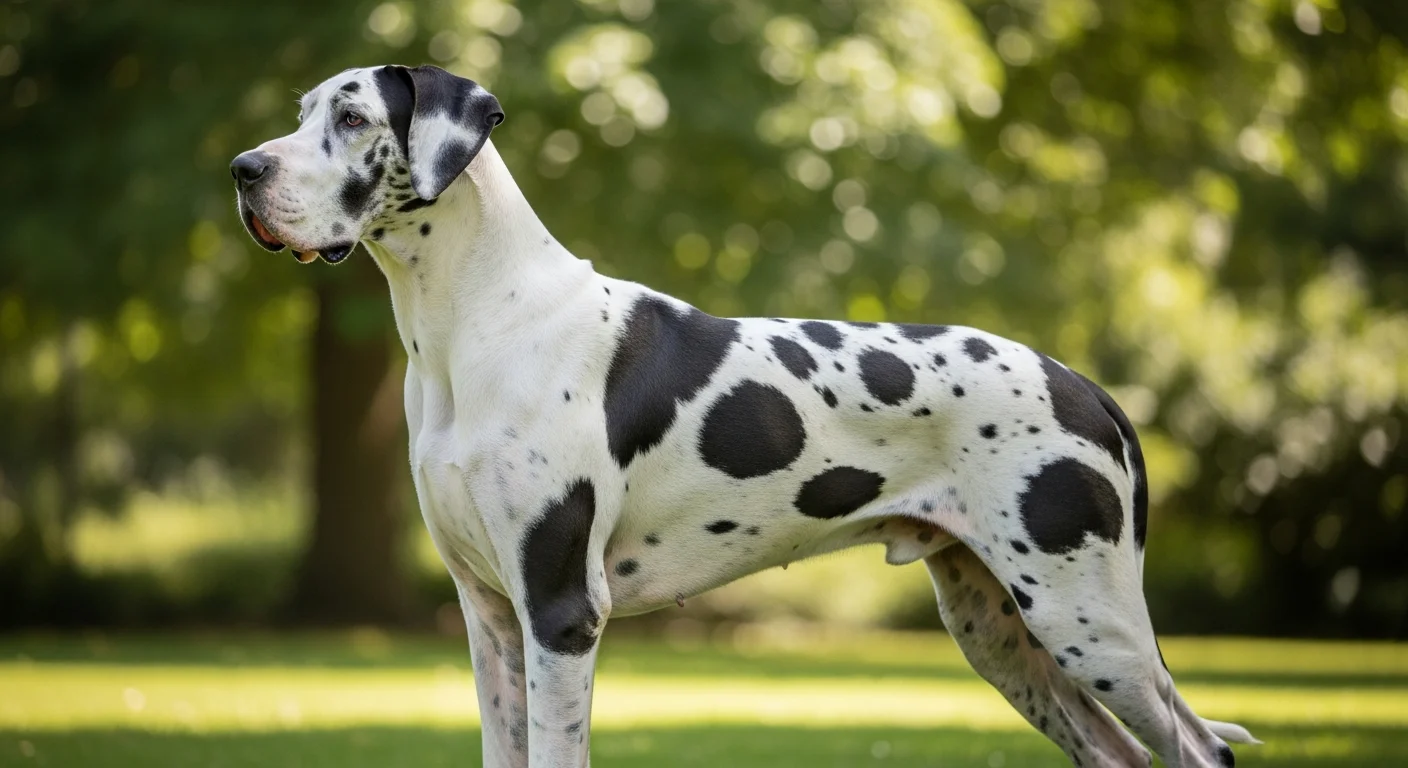
The harlequin gene, abbreviated H, is a dominant modifier that interacts exclusively with the merle pattern. On its own, in the absence of merle, the H gene produces no visible change. On a non-merle dog, harlequin is invisible. It only expresses itself when a dog also has at least one merle allele.
When H is present alongside merle, it transforms the diluted grey areas that merle normally creates. Instead of grey patches, those areas become white. The result is not grey-and-black marbling (as in classic merle) but crisp black-on-white — the harlequin pattern.
The molecular mechanism involves PSMB7, a gene near the harlequin locus that affects how the merle insertion interacts with pigment cells. The H allele essentially takes the diluted regions of a merle coat and pushes them all the way to white, removing the grey intermediate.
The Genetics: Why Harlequin Is Always Heterozygous
Here is the remarkable fact about harlequin that makes it unique in canine genetics: homozygous harlequin (HH) is lethal in utero. Embryos inheriting two copies of the H allele do not survive to birth. This means every living harlequin Great Dane in existence is heterozygous — one copy of H, one copy of the non-harlequin allele (Hh).
This lethal homozygosity has immediate practical consequences. When you breed two harlequin dogs:
- 25% of fertilized eggs would be HH — these die early in development
- 50% would be Hh — harlequin pattern (if also merle)
- 25% would be hh — no harlequin modifier
The loss of 25% of potential embryos means harlequin-to-harlequin breedings produce smaller litters on average. This is a real cost breeders must consider.
The Harlequin × Merle Interaction Table
Since harlequin is only visible in the presence of merle, the actual coat pattern depends on what merle genotype the dog carries alongside H. Great Dane breeders work with this table constantly:
H Gene Outcomes by Merle Genotype
- H + MM (double merle): White dog, often with deafness and blindness
- H + Mm (single merle): Harlequin — white base with black patches
- H + mm (non-merle): Mantle or black-and-white — no harlequin effect visible
- h + Mm (merle, no H): Classic merle — grey and black marbling
- h + mm (no merle, no H): Black, fawn, or brindle depending on other genes
Merle Dane Colors That Emerge From This System
The interaction of H and M produces the suite of recognized Great Dane colors. Breeders who work with harlequin must understand all the possible outcomes from each breeding pair.
Harlequin (Hh Mm) — the classic pattern: white background with torn black patches throughout the body.
Merle (hh Mm) — grey and black marbled coat without white background. Recognized in Great Danes but less common in show lines.
Mantle — black and white pattern in Great Danes, essentially a Mm dog with harlequin modifier in a non-merle area context. The exact genetics are complex and breed-specific.
White (Hh MM or hh MM) — predominantly or entirely white dogs resulting from double merle genetics, carrying significant risk of deafness and vision impairment due to lack of pigment in the inner ear and retina.
Health Implications of Merle-on-Merle in Harlequin Lines
When breeding for harlequin, the merle allele must be managed carefully. Breeding two merle dogs — whether both are harlequin, or one is harlequin and one is merle — risks producing double merle offspring. Double merle dogs carry serious health risks including congenital deafness (BAER test recommended) and microphthalmia (abnormally small eyes), sometimes blindness.
These risks are the same as those I describe in detail in the merle genetics article. Harlequin breeding amplifies these risks because the H gene pushes breeders toward merle matings that can inadvertently produce double merle whites.
Responsible harlequin breeding in Great Danes typically involves pairing harlequin (Hh Mm) with mantle or black (mm) dogs to avoid double merle combinations.
Why Harlequin Only Exists in Great Danes
The H allele appears to be a Great Dane-specific genetic variant. It is not found in other breeds. Other breeds that have black-on-white patterns achieve them through entirely different mechanisms — mostly through the S locus (piebald) without any interaction with merle.
This breed specificity is one of the fascinating aspects of breed-specific color genetics. Different breeds have developed their characteristic colors through different genetic routes, and the harlequin Great Dane is one of the most extreme examples of a breed-unique modifier gene.
DNA Testing for Harlequin Breeding Programs
DNA testing for both the H locus and the M locus is essential in Great Dane harlequin breeding programs. You need to know:
- Whether each breeding candidate carries H (no homozygous dog will exist, so any H-positive dog is Hh)
- The exact merle allele length for each dog — particularly important for identifying cryptic merle carriers that could produce unexpected double-merle offspring
- Whether mantle dogs carry the H allele silently (no merle present, so H is not visible)
For laboratories that offer these panels, the color testing labs comparison provides a current overview of options.
The Broader Lesson of Harlequin Genetics
Harlequin Great Dane genetics is one of the best examples of how coat color genetics can involve modifier genes that require specific contexts to express, lethal allele combinations, and interactions between multiple loci that produce entirely unexpected outcomes.
For any breeder who finds themselves drawn to complex color genetics, harlequin is a masterclass. And the principles it illustrates — modifier genes, conditional expression, lethal homozygosity — appear across many other genetic systems in dogs, not just color. The fundamentals are always the same, as I lay out in Color Genetics 101.
Further Reading
For herding breed enthusiasts interested in merle-related color and health topics, particularly in Australian Shepherds and Border Collies, visit our partner site The Herding Gene.