When I first explain coat color genetics to a new student, I start with single loci. One gene, two alleles, a Punnett square. It is clean and logical. But real dogs are not monocolor puzzles — they are multi-locus systems where genes interact, override, and modify each other in ways that can only be understood when you look at the full picture. That is what epistasis is about.
Epistasis is the phenomenon where the expression of one gene is affected by the presence of alleles at a different gene. In coat color genetics, epistasis is not the exception — it is the rule. Understanding it transforms your ability to predict and explain coat colors that seem to defy simple single-locus logic.
The Definition of Epistasis
Epistasis (from the Greek "to stand upon") occurs when an allele at one locus masks or modifies the expression of alleles at another locus. The gene doing the masking is called epistatic; the gene being masked is hypostatic.
This is distinct from dominance, which occurs between alleles at the same locus. Epistasis involves two different genes interacting across loci. It is gene-to-gene interaction rather than allele-to-allele interaction.
The foundations of how individual genes work — alleles, dominance, homozygosity — are prerequisite knowledge for understanding epistasis. If those concepts are not yet clear, I recommend starting there.
Classic Example: E Locus Epistasis Over B Locus
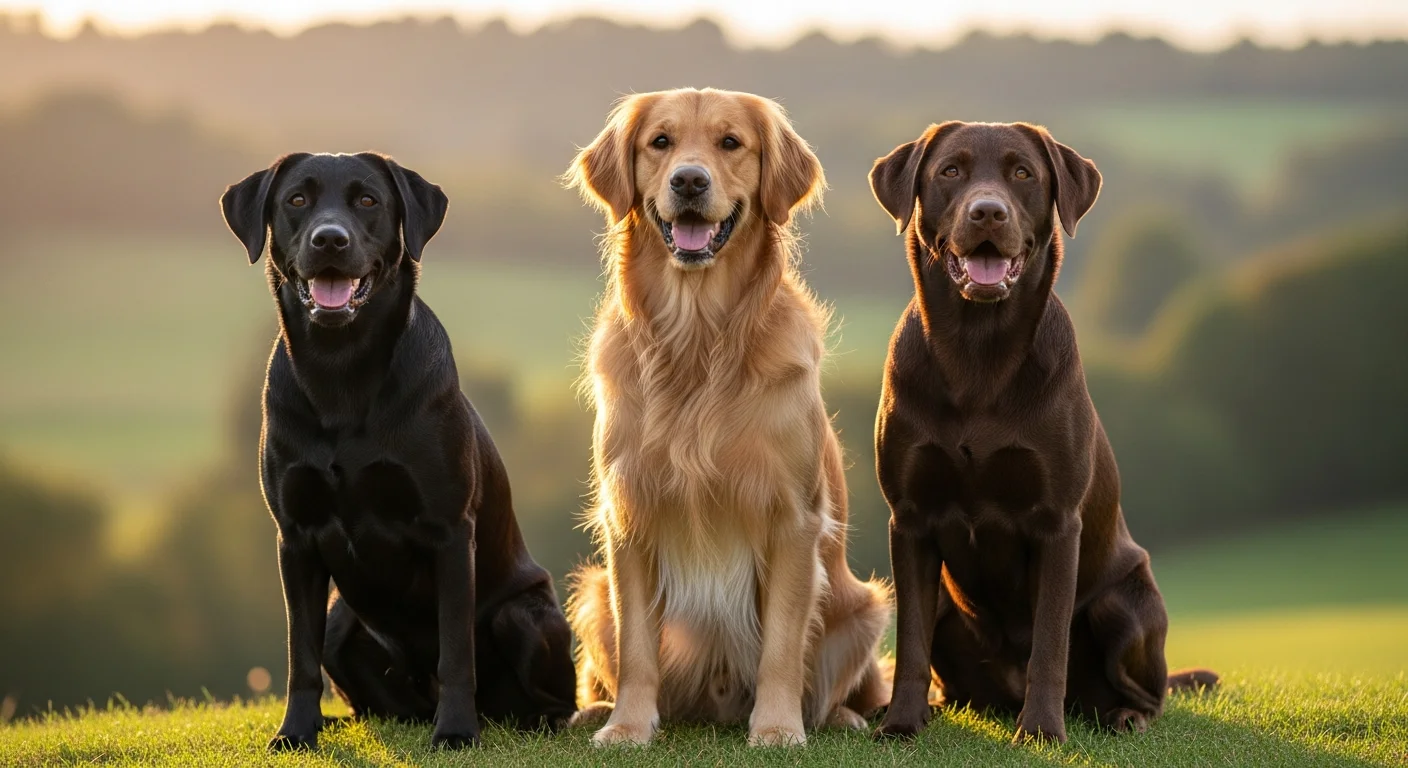
The most commonly cited example of epistasis in canine coat color is the relationship between the E locus and the B locus. When a dog is homozygous recessive at E (ee), the E locus is epistatic to the B locus. The B locus is hypostatic — its alleles are there, but they cannot be expressed in the coat.
A yellow Labrador might be BB ee, Bb ee, or bb ee. All three look yellow. The B locus alleles — whether both black, one black, or both chocolate — are invisible in the coat. However, they are not invisible in the nose: a bb ee dog will have a liver-colored nose, revealing the hidden B locus genotype.
The full story of this interaction is covered in the E locus article. Here, the key point is that the E locus epistasis means you cannot determine a yellow dog's B locus status from its coat color alone.
K Locus Epistasis Over A Locus
A second critical epistatic relationship involves the K locus and the A locus. The K locus (dominant black) is epistatic to the A locus (agouti/pattern).
Dogs that are homozygous dominant at K (KBKB) or heterozygous (KBky) express dominant black. The A locus is completely overridden — sable, tan points, agouti, none of it shows. The dog is black.
Only when a dog is homozygous recessive at K (kyky) does the A locus get to express. This is why two black dogs that carry the ky allele at K AND the tan point allele at A can produce tan-pointed offspring — the K locus epistasis is lifted in those puppies.
The K locus is covered in depth in the K locus article. Its epistatic relationship with A is one of the most important multi-locus interactions in all of canine coat genetics.
E Locus Epistasis Over A and K Loci
The E locus is epistatic not just to B, but to the entire dark-pigment expression system. When a dog is ee, no dark pigment reaches the coat. This means:
- K locus dominant black cannot express (no eumelanin in coat)
- A locus patterns cannot express their dark components (no eumelanin in coat)
- B locus alleles are invisible (eumelanin is absent)
- D locus dilution has no eumelanin to dilute
The ee dog is, in effect, at the top of the epistatic hierarchy for this category — it overrides all of the dark pigment genetics in the coat. This is why it is useful to evaluate loci in a specific order when working through a coat color prediction. Start with E: if the dog is ee, stop analyzing the dark pigment path.
The Hierarchy of Color Loci
One of the most practical tools for understanding multi-locus genetics is a hierarchy of epistatic dominance. Not all hierarchies are absolute (context matters), but this general order applies in most cases:
- E locus — controls whether eumelanin can express in the coat. ee = no eumelanin, full epistasis over everything else.
- K locus — controls whether pattern (A locus) can express. Dominant black overrides A locus.
- A locus — controls the pattern of eumelanin and phaeomelanin distribution (sable, agouti, tan point, recessive black).
- B locus — modifies eumelanin from black to brown. Only relevant if eumelanin is present.
- D locus — dilutes whatever eumelanin exists. Only relevant if eumelanin is present.
- S locus, merle, ticking, etc. — pattern and distribution modifiers acting on already-established color.
Using this hierarchy helps you work through complex coat color analyses systematically rather than guessing. I apply it in the A, B, C, D, E loci guide.
When Multiple Recessive Alleles Interact
Some of the most surprising coat color outcomes involve multiple recessive alleles being expressed simultaneously across different loci. Consider a dog that is:
- bb — homozygous chocolate
- dd — homozygous dilute
- atat — homozygous tan point
The result would be a diluted-chocolate tan-pointed dog — lilac (isabella) with tan points. This is a color that would only appear when all three recessive combinations are expressed simultaneously. The probability of this in any single puppy from two carriers at all three loci would be 0.25 × 0.25 × 0.25 = 1.56% — very rare, but possible. This connects to the probability discussion in the inheritance math article.
Incomplete Penetrance and Variable Expressivity
Two related concepts often arise in discussions of multi-locus genetics: incomplete penetrance and variable expressivity.
Incomplete penetrance means that not all dogs with the "right" genotype for a trait actually show that trait. Environmental factors, modifier genes, and other genomic context can mean that a genotype that usually produces a phenotype fails to do so in some individuals.
Variable expressivity means that the same genotype can produce different degrees of the same phenotype in different dogs. Two spsp piebald dogs may have dramatically different amounts of white — one mostly white, one half-white — because modifier genes adjust the expressivity.
Both phenomena are common in coat color genetics and explain why DNA predictions are probabilistic ranges rather than guarantees. The genome is not a simple program — it is a complex regulatory network where context shapes outcomes.
Practical Application: Working Through a Real Example
Suppose a breeder has two solid black dogs and wants to predict what colors could appear in litters. Neither dog has been DNA tested yet. Visually, both are black. What do they need to know?
- E locus: Are they capable of expressing eumelanin? Almost certainly yes (they are black). But could one carry e? Possibly, meaning some puppies might be yellow/cream.
- K locus: Are they dominant black or are they black via the A locus? Important because it determines whether tan point patterns could emerge.
- B locus: Do either carry chocolate? If yes, chocolate puppies are possible.
- A locus: If K locus analysis reveals they are ky at K, what A locus alleles do they carry?
Without DNA testing, this is all unknown. DNA testing resolves the uncertainty immediately, which is why I consistently recommend it in the DNA testing guide.
Why Coat Color Is a Window Into Broader Genetics
The principles of epistasis I have described — one gene overriding another, multiple genes producing unexpected combined outcomes, context determining expression — apply throughout the genome, far beyond coat color. Health conditions, behavioral traits, and structural features all involve similar multi-gene interactions.
Coat color is an accessible, visible entry point for understanding these principles because we can see the outcomes immediately. The breeders who deeply understand coat color genetics often find that the same analytical framework helps them think about health genetics and other heritable traits in their dogs.
Further Reading
For herding breed breeders interested in applying multi-locus genetics to merle, eye color, and health-related traits, visit our partner site The Herding Gene.