Not every coat color gene produces clinical disease when paired with itself. Most do not. A dog that inherits two copies of the black allele is simply black. A dog that inherits two copies of the yellow allele is yellow. For a handful of specific genes, however, homozygosity or trans-heterozygous interaction produces severe welfare outcomes. These are the double-dilute and lethal-white configurations that every breeder working with color genetics must understand before planning a mating.
The term "lethal white" is applied imprecisely in breeder discussions. Sometimes it refers to double merle dogs with deafness and microphthalmia. Sometimes it refers to overo-pattern horses with intestinal aganglionosis. Sometimes it refers to double-extreme-piebald dogs in certain breeds. Each of these is a different genetic scenario with different consequences. This article walks through the genetic mechanisms one at a time so breeders can apply the correct label and the correct preventive strategy.
Double Merle (MM): The Most Common Lethal-White Scenario
Double merle is the most frequently discussed and most well-understood lethal-white configuration in dogs. The M allele, a mutation in the SILV/PMEL gene, produces the visible merle pattern in heterozygous dose (Mm). In homozygous dose (MM), the mutation disrupts melanocyte development in tissues beyond the skin, including the stria vascularis of the inner ear and the pigmented layers of the eye.
Double merle dogs are typically mostly white because the mutation blocks pigment deposition across most of the body. They show characteristic health outcomes including congenital sensorineural deafness (approximately 25 to 30% unilateral or bilateral), microphthalmia (small or absent eyes) in 15 to 25% of cases, and a range of ocular abnormalities including colobomas, persistent pupillary membranes, and startle nystagmus. The magnitude of these effects was established in controlled studies cited in our merle genetics overview.
Cryptic Merle and Its Hidden Danger
The merle allele is a variable-length insertion within the SILV gene. Short insertions produce the "cryptic merle" phenotype, where the dog carries a functionally active merle allele but shows little or no visible merle pattern. Cryptic merles can produce double merle offspring when bred to a visible merle, because the cryptic carrier contributes an M allele that the breeder cannot see in the parent's coat.
This is the scenario that produces most accidental double merle litters. The breeder intends a merle-to-solid pairing and does not realize the solid parent is actually a cryptic merle. Commercial merle length testing, now widely available, measures the SILV insertion length and classifies each allele as non-merle, cryptic, atypical, merle, or harlequin. Without this test, breeders working with merle breeds are breeding blind to a well-characterized risk.
The same logic of hidden carriers applies outside coat color. A dog can look normal and still pass on a trait that only shows up in the next generation. Breeders who want to understand how recessive traits stay invisible in a population can look at how other fields handle the same problem. Private drug treatment centers face a comparable challenge: the signs of a substance use disorder are often subtle, and families must decide what to do without a clear diagnosis. Their guide covers treatment by substance, levels of care, and the questions families should ask before choosing a private program.
Sealed White in Bull Terrier Line: Piebald-Double-Piebald
In heavily piebald breeds, homozygosity for the most extreme S allele produces a predominantly white dog with elevated deafness rates. This is not exactly analogous to merle-merle homozygosity — the mechanism involves failure of melanocyte migration to the inner ear rather than post-migration cell death — but the clinical consequence is similar. In Dalmatians, where essentially all individuals are homozygous for the extreme piebald allele, approximately 30% show at least unilateral deafness. In Bull Terriers and Boxers, the white variants also show elevated deafness rates.
Breeding decisions in these breeds depend on the population's genetic architecture. In Dalmatians, the entire breed is homozygous piebald by definition — the question is not whether to produce piebald but how to manage the deafness risk via BAER testing. The S locus guide explains the locus in depth.
Harlequin in Great Danes: Merle-Harlequin Trans Heterozygosity
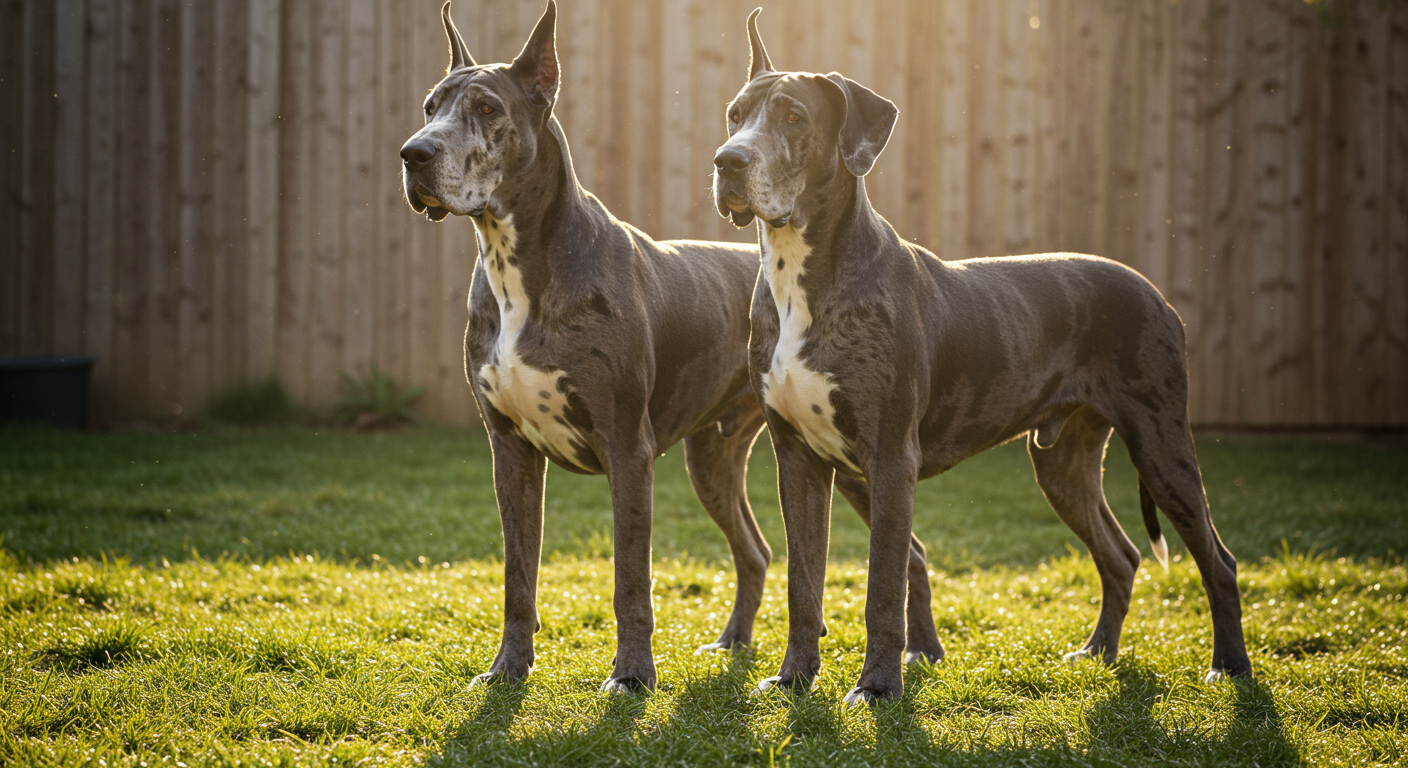
Great Danes show a specific and hazardous genetic configuration involving the PSMB7 harlequin modifier. When a Great Dane is heterozygous for merle (Mm) and heterozygous for harlequin (Hh), the result is the visible harlequin pattern with white background and black torn patches — the classic Great Dane harlequin phenotype. The harlequin modifier is lethal in homozygous dose (HH), so harlequin-to-harlequin breedings produce an expected 25% HH embryos that die in utero and are reabsorbed, reducing litter size.
The additional risk arises in harlequin-to-merle breedings that produce MM/Hh offspring — these show the same health issues as standard double merle plus the harlequin disruption, typically producing severely compromised individuals. Our harlequin gene guide walks through the specific pedigree analysis that prevents these accidental combinations.
What Breeders Should Do Before Every Breeding
The prevention protocol is simple in principle and rigorous in practice. Every breeding dog in a color-risk breed should have full coat color genotyping including, at minimum, the M locus (merle length test), the S locus (piebald status), and the H locus for Great Danes. The DNA testing landscape is covered in detail in the DNA testing guide, and the laboratory comparison covers which labs offer which tests.
Armed with genotype data for both prospective parents, the breeder can predict the possible offspring genotypes using Punnett squares and eliminate any combination that would produce a homozygous high-risk genotype. This is not optional diligence — it is the baseline ethical expectation for anyone producing puppies in a color-risk breed.
Configurations to Avoid
| Parent 1 | Parent 2 | At-Risk Offspring Genotype | Expected Proportion |
|---|---|---|---|
| Merle Mm | Merle Mm | Double merle MM | 25% |
| Merle Mm | Cryptic merle Mcm | Double merle MM | 25% |
| Harlequin MmHh | Harlequin MmHh | MM and/or HH combos | > 25% combined |
| Extreme piebald ss | Extreme piebald ss | ss with elevated deafness | 100% in piebald breeds |
When a High-Risk Puppy Is Born
Despite best efforts, affected puppies occasionally appear — a cryptic merle not identified by older testing protocols, a laboratory error, an unexpected pedigree fact. Responsible handling of an affected puppy includes BAER hearing testing, ophthalmologic examination, and careful placement in a home prepared to manage the specific needs. Deaf-and-blind double merle dogs can live full lives with appropriate accommodation, but placement requires transparent disclosure and a committed adopter.
The puppy is never the problem. The breeding decision was the problem. Genuine responsibility starts with acknowledging that, documenting what went wrong, and updating the breeding protocol so it does not recur. Breeders who blame the puppy or obscure its status are failing the breed and the broader dog-owning public.
For a Bull Terrier carrying the piebald pattern, the practical question is which tests to request and what to monitor. A DNA panel for piebald (MITF) and, where relevant, merle and harlequin markers clarifies the genotype, while BAER testing assesses hearing, since pigment-associated deafness is the main risk. Ask the breeder for results on both parents, and check the Bull Terrier genetic health page for how French breeders document these tests. Watch for skin and eye issues linked to white pigmentation, and repeat BAER testing in puppies before placement.
Owners of double dilute or lethal white puppies often ask what can still be done once veterinary care is in place. Some turn to bodywork: canine massage, TTouch, physiotherapy and underwater treadmills are described in movement and hands-on therapy for dogs, including who practises these methods in Germany, what a session costs, and where the limits lie. Such work does not change a dog's genotype, and it is not a substitute for veterinary assessment. It may, however, support comfort and mobility in dogs whose condition is already managed. Ask the practitioner about qualifications and realistic goals before booking.
Clinical Summary
Double-dilute and lethal-white scenarios are preventable with complete DNA testing and informed breeding decisions. Merle-to-merle, merle-to-cryptic, and harlequin-to-harlequin pairings all carry predictable and avoidable welfare costs. The ethical floor is not negotiable.