A breeder once asked me: "I got my dog tested for brown at two different labs and got different results. How is that possible?" The answer is that they tested for different mutations. Both results were technically correct. This kind of confusion is common when breeders do not understand what different laboratories are actually testing. This guide will help you avoid that problem.
Canine color DNA testing has advanced considerably over the past decade, but not all panels are equal. What one laboratory calls a "full color panel" may test fewer mutations than another laboratory's basic package. Understanding the landscape before you order will save you money, confusion, and — critically — prevent you from making breeding decisions based on incomplete data.
What DNA Color Tests Actually Measure
Every DNA color test works by analyzing specific mutations in specific genes. The key word is specific. A test for the b allele at the B locus might check for one known mutation (bc) or all four known mutations (bc, bd, bs, ba). A dog that is clear on a single-mutation test could still carry a different b variant and produce chocolate offspring.
This issue is most significant for loci where multiple distinct mutations have been discovered:
- B locus (chocolate/liver) — At least four mutations known. A test checking only bc misses dogs carrying bd, bs, or ba.
- D locus (dilution) — At least two primary mutations (d1 and d2). Tests vary in which they include.
- E locus (extension) — Multiple e variants reported; good panels check all known ones.
- A locus (agouti) — Several alleles exist (ay, aw, at, a). Testing all of them requires a comprehensive panel.
The connection between this and the fundamentals is direct: if you do not understand what genes are at play, you cannot evaluate whether a test is adequate. The A, B, C, D, E loci guide provides that foundation.
Major Testing Providers: An Overview
Several reputable laboratories offer canine color DNA testing. Here is an overview of the major options and their relative strengths:
UC Davis Veterinary Genetics Laboratory (VGL)
The UC Davis VGL is a research institution laboratory with a strong scientific reputation. Their panels have historically been among the most comprehensive, particularly for mutations discovered through academic research. Turnaround times can be longer than commercial labs. Pricing is moderate. Particularly recommended for breeds where newer or less common mutations are relevant.
Embark Veterinary
Embark is primarily marketed as a consumer breed and health testing service, but their color genetics reporting is included and reasonably comprehensive. Embark tests a large number of color loci simultaneously. Reporting is consumer-friendly but can be less detailed than a specialist laboratory for professional breeders who need specific allele designations rather than visual predictions.
Wisdom Panel
Another consumer-focused panel that includes color genetics. The breadth of color loci tested has improved in recent years. Suitable for general interest and breed identification, but breeders who need precise allele information for specific breeding decisions may want to supplement with a specialist panel.
Animal Genetics (Genomia, Laboklin)
Several specialist veterinary genetics laboratories, including Animal Genetics in the United States, Genomia in Europe, and Laboklin internationally, offer targeted color panels. These labs are often preferred by professional breeders because:
- You can order specific tests rather than a general panel, reducing cost when you only need a few loci
- Results are reported in standard genetic notation (allele designations)
- Many have breed-specific panels developed in consultation with breed clubs
How to Read Color Test Results
Results from specialist labs typically report each locus with the genotype in standard notation. For example:
- B locus: B/b — Heterozygous, carries one black allele and one chocolate allele (carrier)
- D locus: D/D — Homozygous dominant, no dilution
- E locus: E/e — Carries one extension and one recessive allele (carrier of yellow)
- A locus: at/at — Homozygous tan point
Consumer lab reports often translate this into visual predictions ("your dog is likely to produce cream puppies when bred to a yellow carrier") rather than showing raw genotypes. For breeding program management, knowing the genotype is more valuable than a visual prediction. The math behind these predictions is covered in the Punnett square guide.
The Merle Test: Why This One Requires Special Attention
Merle testing deserves separate mention because it is not a simple allele test. The merle gene involves a variable-length SINE insertion, and the length of that insertion determines whether a dog is non-merle, cryptic merle, classic merle, or harlequin merle. A test that only reports "merle positive/negative" misses critical information.
A quality merle test should report the actual insertion length in base pairs, or at minimum categorize the allele into the standard length categories (cryptic, atypical, classic, harlequin). This is the only way to identify cryptic merle carriers — dogs that look non-merle but carry a short merle allele that can expand in offspring.
The risks of missing cryptic merle are serious: breeding what appears to be a non-merle to a merle can inadvertently produce double-merle offspring if the "non-merle" is actually a cryptic merle. I cover these risks in the merle genetics article.
What to Test: A Locus-by-Locus Priority Guide
Not every breeder needs to test every locus. Here is a practical guide to which tests matter most in different situations:
High Priority Tests by Situation
- Breeds with chocolate/liver: Full B locus panel (all four variants)
- Breeds with dilute dogs or dilute history: Full D locus panel (d1 and d2 at minimum)
- Breeds with yellow/cream/red dogs: E locus, plus intensity modifiers if shade matters
- Breeds with merle: Quantitative merle test reporting insertion length
- Breeds with complex patterns: A locus (all agouti alleles) + K locus
- Breeds with white markings where ticking matters: S locus + ticking
The Cost-Accuracy Tradeoff
More comprehensive panels cost more. When budget is limited, prioritize testing the loci most likely to produce unexpected outcomes in your specific breeding program. A Golden Retriever breeder who only breeds yellow-to-yellow rarely needs B locus testing (though it can matter for nose color). A Labrador breeder producing all three colors should test everything.
The hidden cost of not testing is a litter that surprises you — and surprise litters are usually not a positive thing in a managed breeding program. As I emphasize in the DNA testing fundamentals guide, the investment in comprehensive testing almost always pays off in better-predicted outcomes.
Sample Collection and Quality
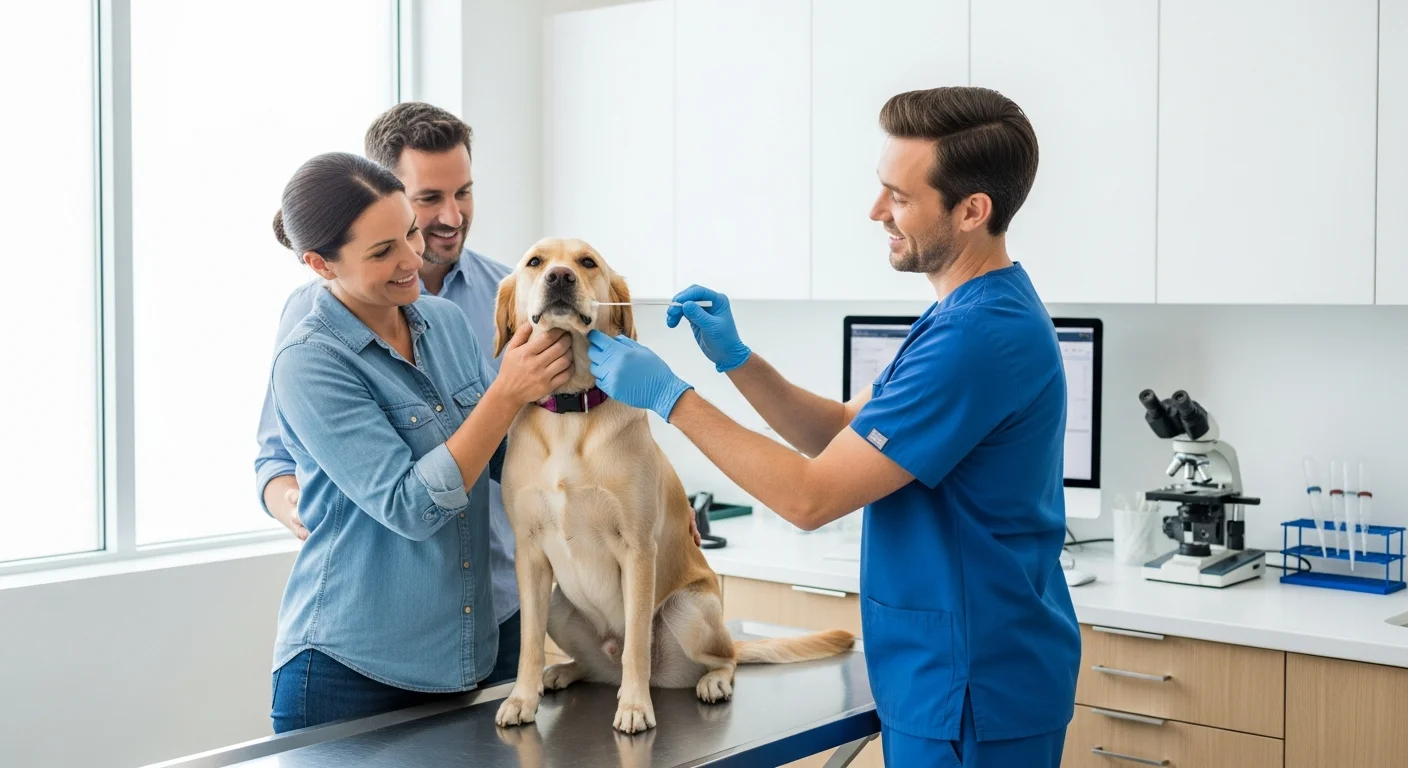
Most laboratories use cheek swabs for sample collection. Buccal swabs are easy to collect at home and reliable when collected correctly. Key tips:
- Do not collect within an hour of the dog eating or drinking
- Swab firmly against the inner cheek for the recommended duration (usually 30-60 seconds per swab)
- Allow swabs to dry completely before packaging
- Use separate swabs for each dog and label immediately
Blood samples provide higher quality DNA and are preferred for some specialized tests, but are not required for standard color panels.
Interpreting Results in the Context of Your Breed
A final note: color test results need to be interpreted in the context of your specific breed's allele frequencies. A result of "carrier of chocolate" means very little risk in a breed where chocolate has essentially never appeared. The same result in a Labrador breeding program is highly actionable.
This is where understanding breed-specific color genetics becomes practically important. Knowing which alleles exist in your breed's gene pool helps you decide which tests to run and how to weight the results you receive.
Further Reading
For herding breed-specific testing recommendations, including MDR1 and color panels relevant to collies and shepherds, visit our partner site The Herding Gene.